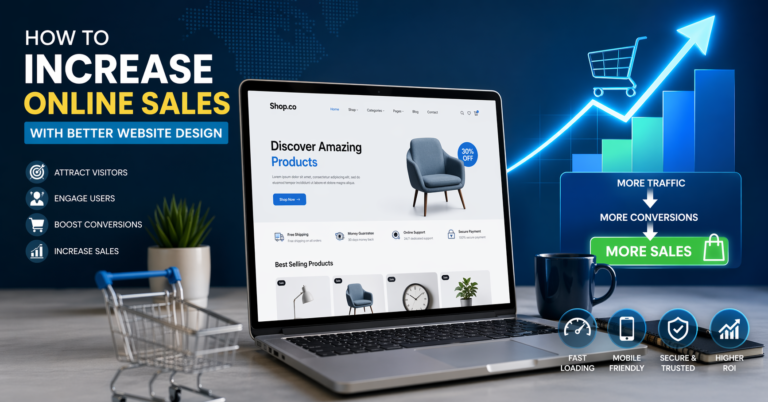
In today’s digital world, your website is not just an online presence—it is your most powerful sales machine. Whether you run an e-commerce store, a service-based business, or even a personal brand, your website design directly impacts how many visitors turn into paying customers.
Many businesses struggle with low sales not because their products are weak, but because their website fails to attract, engage, and convert visitors. A poorly designed website confuses users, slows down their journey, and ultimately pushes them away.
On the other hand, a well-structured, visually appealing, and user-friendly website builds trust, improves user experience, and significantly increases online sales. In this guide, you will learn how better website design can transform your business and what practical steps you can take to improve conversions in 2026 and beyond.
Why Website Design Matters for Online Sales
Website design is more than just colors and images. It is about how users feel when they land on your site. First impressions are formed within seconds, and in that short time, visitors decide whether to stay or leave.
A professional website design helps in:
- Building trust with new visitors
- Improving user experience (UX)
- Guiding users toward purchase decisions
- Reducing bounce rate
- Increasing conversion rates
Think of your website as a digital salesperson. If it looks outdated, slow, or confusing, customers will lose confidence instantly. But if it is modern, clean, and easy to navigate, users are more likely to explore your products and make a purchase.
Essay Writing Assignments
Key Elements of a High-Converting Website Design
To increase online sales, your website must focus on both design and functionality. Let’s explore the most important elements.
1. User Experience (UX)
User experience is the heart of website success. It determines how easily visitors can find what they are looking for.
A good UX design ensures:
- Simple navigation menus
- Clear product categories
- Easy checkout process
- Minimal distractions
If users struggle to find information, they will leave immediately. A smooth experience increases engagement and builds confidence.
2. User Interface (UI) Design
UI design focuses on how your website looks. A visually appealing website creates emotional connection and trust.
Key UI principles include:
- Consistent color scheme
- Readable fonts
- High-quality images
- Balanced layout
A clean UI makes your brand appear professional and reliable, which directly increases sales.
Online Essay Writing
Mobile-Friendly and Fast Website Performance
In 2026, most users browse websites on mobile devices. If your website is not mobile-friendly, you are losing a huge number of potential customers.
A responsive design ensures your website works perfectly on:
- Smartphones
- Tablets
- Desktop computers
Speed is equally important. A delay of just a few seconds can reduce conversions significantly. Optimizing images, using proper hosting, and reducing unnecessary scripts can dramatically improve performance.
Conversion-Focused Design Strategies
A beautiful website is not enough—you need a website that converts visitors into customers.
Call-to-Action (CTA) Optimization
Strong CTAs guide users toward action, such as:
- “Buy Now”
- “Get Started”
- “Sign Up Today”
CTAs should be:
- Visible
- Clear
- Strategically placed
Landing Pages That Sell
A landing page is designed for one goal: conversion. It should remove distractions and focus entirely on the offer.
Effective landing pages include:
- Strong headlines
- Benefits-focused content
- Testimonials
- Clear CTA buttons
SEO and Website Design Work Together
Good website design also improves your SEO ranking. Search engines like Google prioritize websites that are fast, mobile-friendly, and easy to navigate.
SEO-friendly design includes:
- Clean URL structure
- Proper heading hierarchy (H1, H2, H3)
- Fast loading speed
- Optimized images
When your website ranks higher on Google, you get more organic traffic, which naturally increases sales opportunities.
Building Trust Through Website Design
Trust is a major factor in online purchasing decisions. If users don’t trust your website, they won’t buy.
To build trust, include:
- Customer reviews and testimonials
- Secure payment icons
- About Us page with real information
- Contact details
- Professional branding
Trust signals reduce hesitation and encourage users to complete purchases confidently.
Common Website Design Mistakes That Kill Sales
Many businesses unknowingly make mistakes that hurt their sales. Some of the most common ones include:
- Cluttered homepage with too much information
- Slow loading pages
- Poor mobile experience
- Weak or missing CTAs
- Hard-to-read text or bad color contrast
Avoiding these mistakes can instantly improve your conversion rate.
Step-by-Step Strategy to Improve Your Website Sales
If you want to increase online sales through better design, follow this simple strategy:
- Analyze your current website performance
- Improve loading speed and mobile responsiveness
- Redesign UI for clarity and simplicity
- Optimize CTAs and landing pages
- Add trust elements like reviews and security badges
- Improve SEO structure for more traffic
- Test and refine based on user behavior
Website improvement is not a one-time task—it is an ongoing process.
Final Thoughts
Website design plays a critical role in determining your online success. A well-designed website does more than look good—it attracts visitors, builds trust, and converts traffic into sales.
In 2026, competition in the digital world is higher than ever. Businesses that invest in professional, user-focused, and conversion-optimized website design will always stay ahead.
If you want to grow your online sales, start by improving your website experience. Even small changes in design, speed, and usability can lead to significant business growth over time.