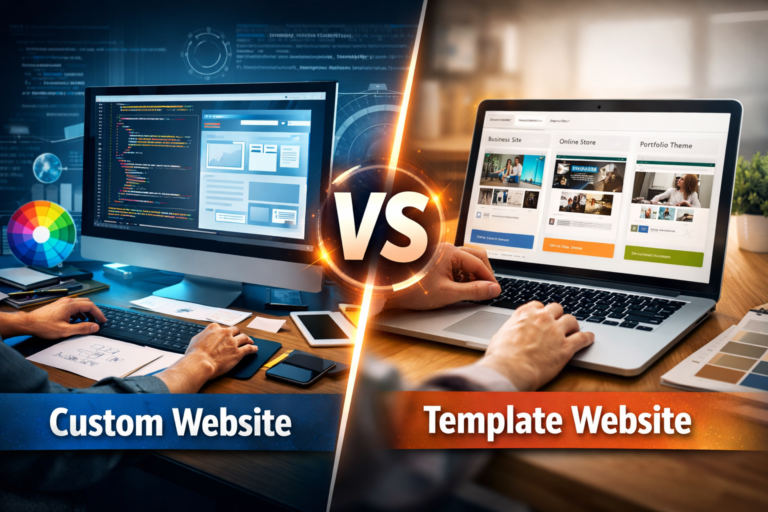
Choosing the right type of website is one of the most important decisions any business can make in today’s digital world. Whether you are launching a startup, growing an existing brand, or moving your business online, your website acts as your digital identity. The question many business owners face is simple but crucial: should you go for a custom-built website or use a ready-made template?
This complete guide will walk you through everything you need to know about custom and template websites. By the end, you will have a clear understanding of which option suits your business goals, budget, and long-term growth strategy.
Understanding Custom and Template Websites
Before diving into comparisons, it is essential to understand what each type of website actually means.
A custom website is built from scratch by developers and designers. Every element, from layout to functionality, is tailored specifically to your business needs. It is unique, flexible, and designed to align perfectly with your brand identity.
On the other hand, a template website uses pre-designed layouts. These templates are available on platforms like WordPress, Shopify, or Wix. You simply choose a design, customize basic elements like text and images, and launch your site quickly.
Both options have their strengths and limitations, and the right choice depends on your specific situation.
Cost Comparison: Investment vs Affordability
One of the biggest factors influencing this decision is cost.
Template websites are generally more affordable. They often require only a small upfront cost, and many platforms offer free or low-cost themes. This makes them an attractive option for startups or individuals with limited budgets.
Custom websites, however, require a higher investment. Since they are built from scratch, you need to pay for design, development, and sometimes ongoing maintenance. While this may seem expensive initially, it is important to consider it as a long-term investment.
If your goal is quick setup with minimal cost, templates are ideal. But if you are building a serious business that requires scalability and uniqueness, a custom website offers better value over time.
Design and Branding: Standing Out in a Competitive Market
Your website is often the first impression customers have of your brand. This is where design plays a crucial role.
Template websites come with pre-designed layouts. While they are visually appealing, they are not unique. Many other businesses may be using the same template, which can make your brand look generic.
Custom websites, on the other hand, are designed specifically for your brand. Every detail, from colors to layout, reflects your business identity. This helps you stand out in a crowded market and build a stronger connection with your audience.
If branding and uniqueness are important to your business, a custom website is clearly the better choice.
Flexibility and Functionality
As your business grows, your website needs to evolve. This is where flexibility becomes essential.
Template websites have limitations. You can customize them to a certain extent, but you are restricted by the features and structure provided by the template. Adding advanced functionality can be difficult or even impossible without significant modifications.
Custom websites offer complete flexibility. You can add any feature you want, whether it is a booking system, advanced e-commerce functionality, or custom integrations. This makes custom websites ideal for businesses with specific requirements.
In simple terms, templates are good for basic needs, while custom websites are built for growth and adaptability.
Essay Writing Assignments
SEO Performance and Optimization
Search engine optimization (SEO) is critical for online success. Your website needs to rank on search engines like Google to attract organic traffic.
Template websites can be SEO-friendly, but they often include unnecessary code and limited optimization options. This can affect loading speed and overall performance.
Custom websites are built with SEO in mind from the start. Developers can optimize every aspect, including speed, structure, and user experience. This gives your website a better chance of ranking higher in search results.
For businesses that rely heavily on online visibility, investing in a custom website can provide a significant advantage.
User Experience (UX) and Performance
User experience is another key factor that determines the success of a website.
Template websites are designed for general use. While they are functional, they may not always provide the best experience for your specific audience.
Custom websites are tailored to your target users. Every element is designed to guide visitors smoothly through your site, improving engagement and conversion rates.
Additionally, custom websites are often faster and more efficient because they do not include unnecessary features. This improves loading speed, which is crucial for both user experience and SEO.
Time to Launch: Speed vs Precision
If you need a website quickly, template websites are the clear winner. You can set up a basic site in a matter of hours or days.
Custom websites take more time. The process involves planning, designing, developing, and testing. This can take several weeks or even months, depending on complexity.
However, the extra time spent on a custom website results in a more polished and effective final product. It is a case of speed versus precision.Online Essay Writing
Maintenance and Support
Maintaining a website is an ongoing process, and it is important to consider how each option handles updates and support.
Template websites are usually easier to maintain. Platforms provide automatic updates, and you do not need advanced technical knowledge.
Custom websites may require professional support for updates and maintenance. While this adds to the cost, it also ensures that your website remains secure and up to date.
Security Considerations
Security is a growing concern for online businesses.
Template websites can be more vulnerable to attacks, especially if they use widely available themes and plugins. Hackers often target common vulnerabilities in popular templates.
Custom websites offer better security because they are built specifically for your business. Developers can implement advanced security measures tailored to your needs.
For businesses handling sensitive data or online transactions, a custom website provides greater peace of mind.
Scalability: Planning for the Future
As your business grows, your website should grow with it.
Template websites may struggle to handle increased traffic or complex features. Upgrading can sometimes require switching to a completely new platform.
Custom websites are designed with scalability in mind. You can easily expand features, improve performance, and adapt to changing business needs.
If you are planning for long-term growth, a custom website is the smarter choice.
Which Option Is Right for You?
The decision ultimately depends on your goals, budget, and business stage.
A template website is ideal if you are just starting out, have a limited budget, and need a quick online presence. It is a practical solution for small businesses and personal projects.
A custom website is better if you are serious about building a strong brand, need advanced features, and want long-term scalability. It is an investment that pays off as your business grows.
Final Thoughts
Choosing between a custom website and a template website is not about which one is universally better. It is about what works best for your specific needs.
Template websites offer simplicity, speed, and affordability, making them a great starting point. Custom websites provide uniqueness, flexibility, and long-term value, making them ideal for growing businesses.
If you are unsure, consider starting with a template and upgrading to a custom solution as your business expands. The key is to align your website with your goals and ensure it supports your journey toward success.